
SHORT ANSWER
Start with the customer question, the intended market and the video itself. A cordless-vacuum example shows how to research terms, choose relevant hashtags, prepare account variations and review results without treating tag volume as a traffic guarantee.

How should a business choose TikTok hashtags?
Start with the question the video answers, then choose terms that describe the product, action and setting accurately. A cordless-vacuum demonstration about sofa crevices should use language relevant to that task. Unrelated trending terms cannot replace a useful demonstration.
Updated November 2026: this guide separates search keywords, public hashtags and account labels, with a product example and a record for reviewing market variations. Check the current publishing interface for available fields and limits.
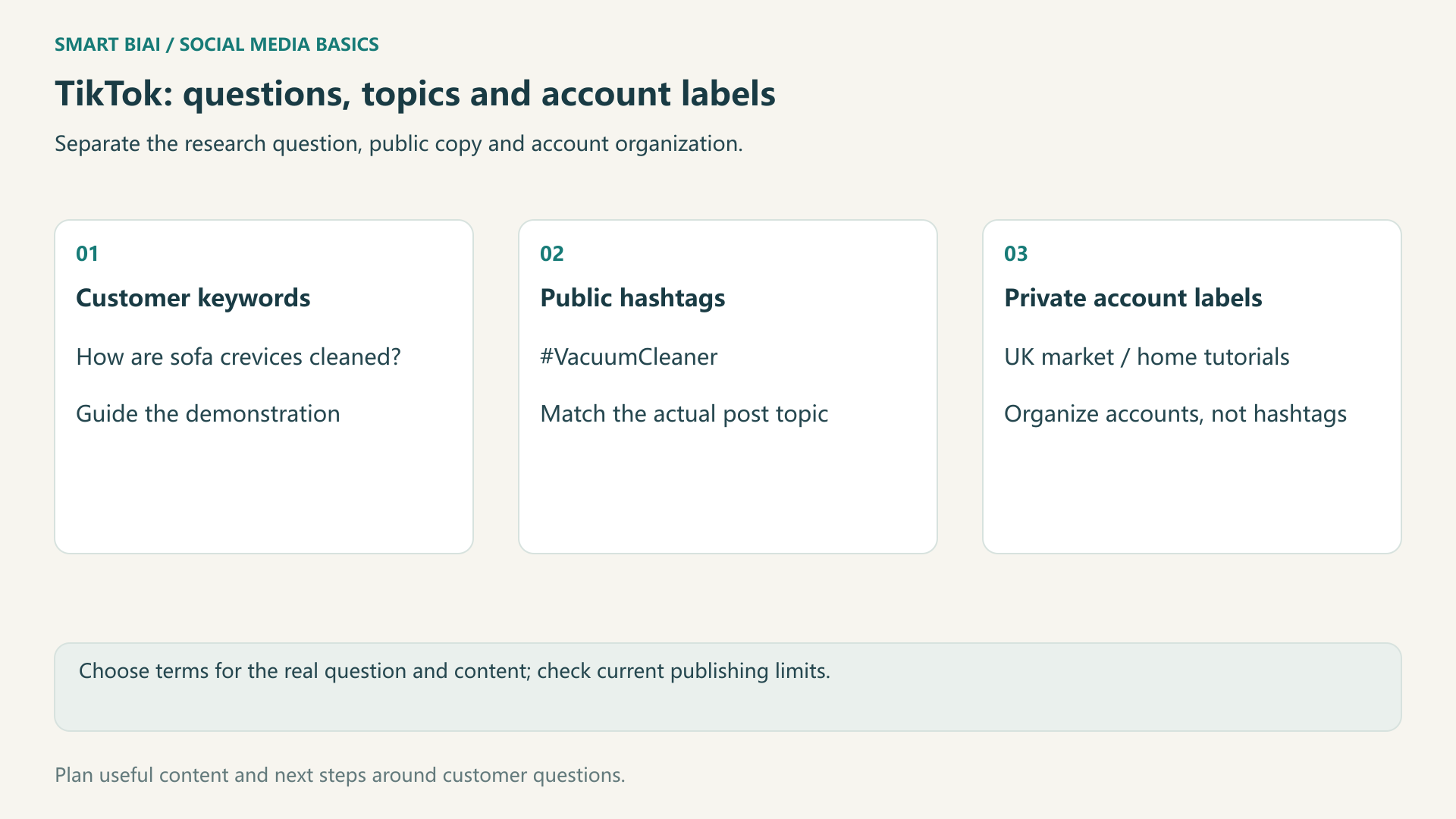
1. Keywords, hashtags and account labels do different jobs
A keyword is a term or question a customer might search for. A hashtag is a public topic expression beginning with #. An account label is a private way to organize accounts in a management tool.
| Item | Where it belongs | Product example | Practical check |
|---|---|---|---|
| Customer keyword | Topic research, titles, speech and captions | How to clean sofa crevices | Answer the question rather than repeat the phrase |
| Public hashtag | Relevant topics in the publishing copy | #VacuumCleaner, #SofaCleaning | Match what the video actually shows |
| Account label | Account organization in tools such as Smart BIAI | UK market, home care, tutorials | A private label is not a public post hashtag |
TikTok lists hashtags among its content signals in its recommendation and search explanation. It also describes matching content to a search query. Relevance should therefore guide the selection, alongside the answer in the video.
2. Build candidates from customer questions and research
Start with questions in sales conversations, product instructions and comments. Cleaning a car crevice and attaching a vacuum head are distinct useful topics, even before you look at a popular hashtag list.
Search in the intended market and examine suggestions, wording and relevant posts. Use these clues for topics, alongside customer questions and actual post feedback. Check whether a term has a different meaning in local content.
Creator Search Insights offers search-topic research where available. Creative Center Trends can add trend context. Check the market, available filters and related work before keeping a candidate. A place on a trend list is not a reason to use an unrelated term.
3. Give each product demonstration its own selection
For a cordless vacuum, first describe the specific task: show how a crevice tool cleans a sofa edge. Consider product, use case and question terms. The examples below show how to adapt the selection to different demonstrations.
| Video question | What the copy should explain | Hashtag candidates to research | Leave out |
|---|---|---|---|
| How are sofa crevices cleaned? | The attachment, fitting and actual action | #VacuumCleaner, #SofaCleaning | Car-cleaning topics absent from the video |
| How is the attachment fitted? | The steps for this product | #VacuumCleaner, #CleaningTips | Unrelated entertainment trends |
| How can it be stored in a small home? | The actual size and storage method | #VacuumStorage, #HomeOrganization | Unverified size or performance claims |
A branded hashtag can connect your own series, but a new viewer may not know the brand. Explain the product and problem first, then add a relevant brand or campaign term if it helps.
4. Adapt the candidate list to the market and account
Reuse research, then adjust the wording to the language, product version and account purpose. A UK home-storage account and a distributor-focused account may show the same product while needing different demonstrations, titles and topic choices.
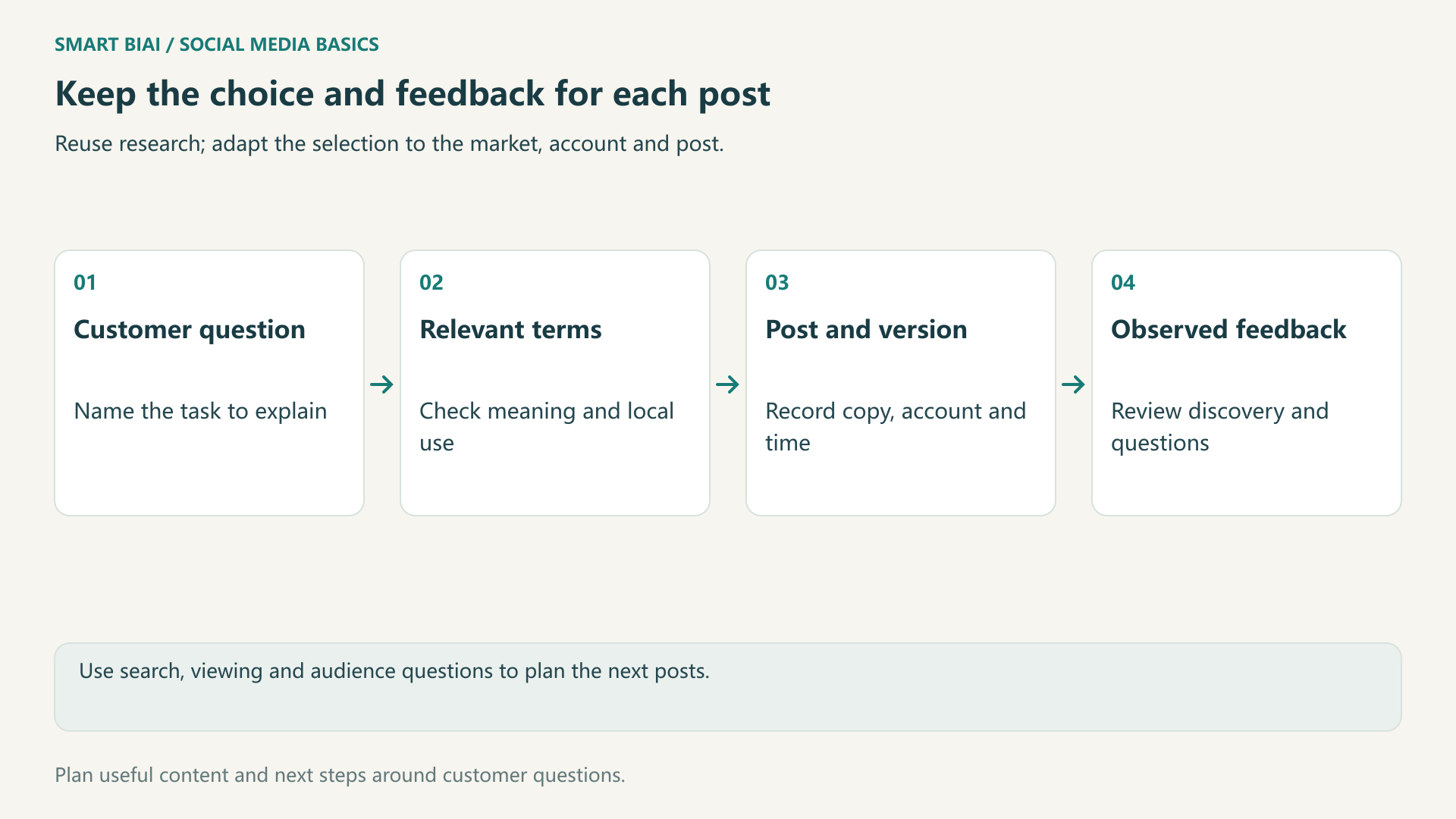
Record the meaning, market, source and posts using each candidate. Keep useful terms and the reasons for choosing them, then adapt the list to each post. Review it when a campaign or a term changes meaning.
5. Review the whole post before crediting a hashtag
Record the topic, market, video structure, publishing time and hashtag version together. If a post changes its footage, opening, copy and tags, a change in views alone cannot identify the cause.
| Record | Question it answers | How to use it |
|---|---|---|
| Post URL, account, market and time | Which posts are being compared? | Separate markets, accounts and periods |
| Question, opening and hashtag version | Does the topic match the content? | Keep useful wording and revise unclear terms |
| Available search and viewing information | How was the content found and watched? | Check the search and viewing information provided by the account |
| Comments, saves and actual inquiries | Did the content answer the question? | Turn recurring questions into later topics |
Compare posts with similar subjects, markets and production methods. Low views are a reason to inspect the explanation and audience response before replacing the entire list.
6. Where Smart BIAI fits
Smart BIAI helps teams organize assets and language versions, manage overseas accounts and arrange content publishing tasks. Relating each post to its intended market and account purpose helps avoid mismatches across a matrix.
Public hashtags belong in the relevant post copy or supported field. Private account labels are for organization. Choose the topics first, then check the copy and hashtag fields supported by your publishing method. See global social media management for the workflow, or discuss video production needs when you need production help.
Continue reading
Questions enterprise teams ask
Must every video use a trending hashtag?
No. A tutorial can use relevant topic terms. Add a trend only when the work genuinely belongs to that conversation.
Do #fyp or #viral guarantee recommendations?
No hashtag should be treated as a recommendation guarantee. Start with relevance and the response to the actual video.
Are search suggestions a search-volume report?
No. They offer wording and topic clues without providing a verified count of independent searches or buyers.
Can we copy a competitor's hashtags?
Study public work, then check your own product, market and content. Do not paste an unrelated combination.
Do Smart BIAI account labels become post hashtags?
Account classification and public post copy are separate. Check both the target account and the hashtags before publishing.
How long should we wait to judge a change?
Review several posts under reasonably similar conditions. There is no fixed waiting period that proves an effect for every account, and one post cannot establish causation.