
SHORT ANSWER
An enterprise AI video budget should cover assets, generation, charged retries, localization, human review, version management and distribution. Divide the total by unique versions that pass review and are published. Generation is billed per second; video processing rounds up per 30 seconds, with additive function charges. Failed or cancelled tasks return credits, so tool costs should use net consumption.

Article
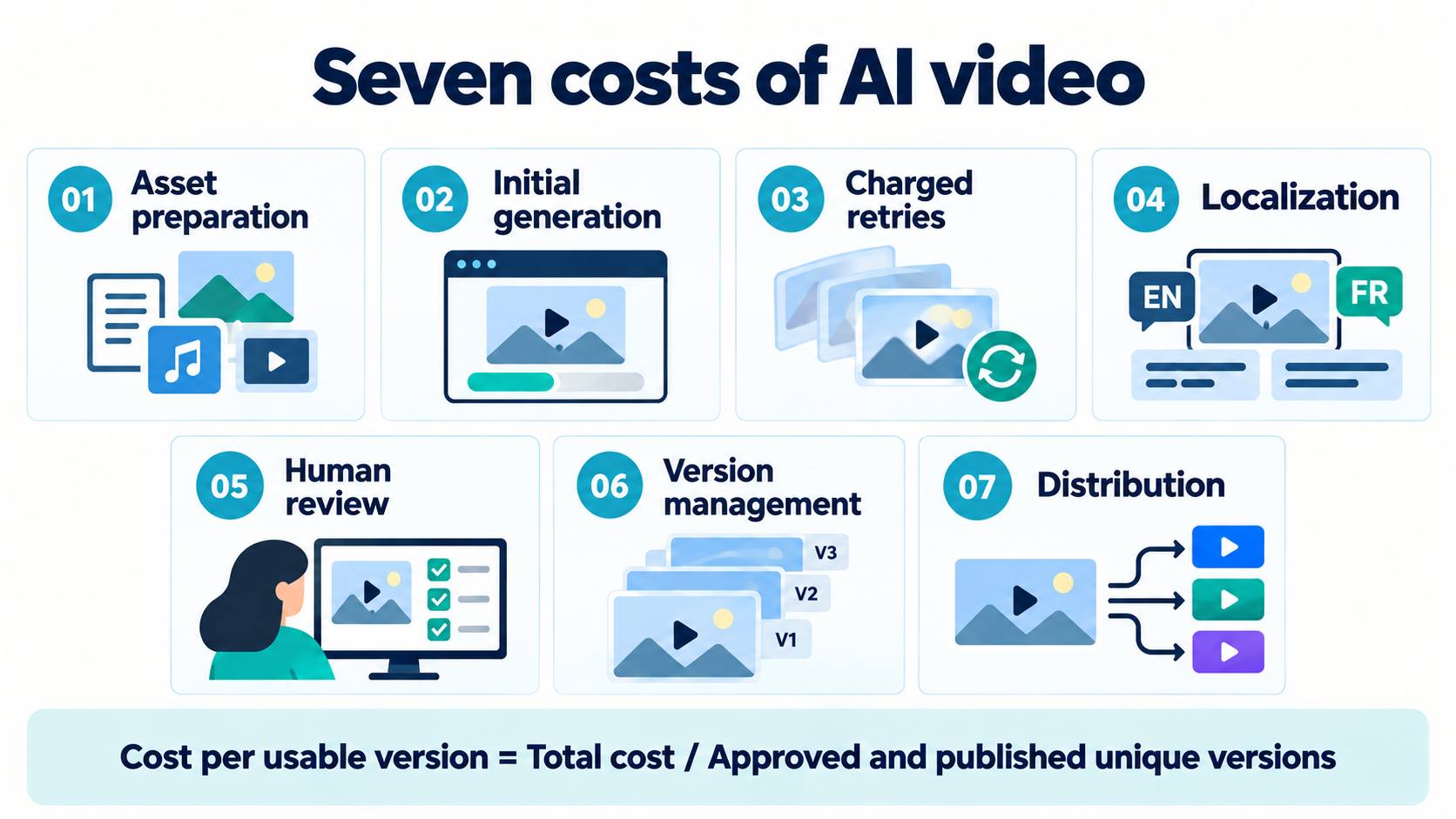
An enterprise AI video budget should cover seven categories: assets, generation, charged retries, localization, review, version management and distribution. Divide the total by the number of unique versions that pass review and are actually published to compare the cost of the complete workflow.
This guide is for marketing, production, brand and procurement teams. It introduces a cost framework and three stages of estimation. This revision adds model credits, processing units and task refund rules reviewed on 12 October 2026. Credit tables show reference billing information; the worked CNY budgets are illustrative assumptions, not market averages, customer results or Smart BIAI quotes. No currency conversion is implied.
What should an enterprise AI video budget measure?
First choose the unit: a generated clip, an edited video or a reviewed market version that has been published. These units include different amounts of work.
Total project cost = Asset preparation + Initial generation + Charged retries + Localization + Human review + Version management + Distribution.
Cost per usable version = Total project cost / Unique finished versions that pass review and are published.
A unique version is a distinct deliverable file. Uploading the same file to four accounts still counts as one version. Separate language, aspect-ratio or content files can count separately when they are actually published. Approved files awaiting publication belong in a separate status. When no versions have been published, this metric cannot yet be calculated.
Use planned deliverables for the budget and actual published deliverables for the review of results. Record the difference. Each version should connect to its source assets, production task, approval record and published link.
Which seven costs belong in the budget?
The model charge is one component. A project ledger should connect software usage and human work to specific tasks.
| Cost category | What to record | Frequently missed work |
|---|---|---|
| Asset preparation | Product facts, scripts, images, video, brand rules, permissions and preparation time | Reshoots, asset sourcing, parameter checks and licensed materials |
| Initial generation | Model, input type, billing unit, duration, resolution and first-attempt charges | Additional shots, configuration differences and extra processing |
| Charged retries | Actual charges for later generations and reprocessing | Rejected outputs and new tasks after revisions; subtract refunded charges |
| Localization | Translation, voice, subtitles, on-screen text, terminology and market checks | Re-editing for longer speech, model-name pronunciation and replacement audio |
| Human review | Time spent checking facts, brand, visuals, audio, captions and channel requirements | Handoffs, repeat checks and revisions following review |
| Version management | Naming, storage, covers, aspect-ratio files and allocated collaboration costs | Exports, transcoding, downloads and locating the final file |
| Distribution | Publishing configuration, scheduling, execution, status checks and link records | Manual operations and corrections after publishing failures |
Assign each charge to one category. Initial generation and retries should not overlap. Translation software and translators belong under localization; brand reviewers belong under human review.
Paid media, creator partnerships and specialist legal reviews are excluded from the worked budgets below. Add them when your project requires them, and use the same boundaries when comparing tools.
How do models, duration, resolution and retries affect cost?
Start with the billing unit. Per-second, per-task, credit-based and other charges need a consistent currency and scope before comparison.
For tasks billed by generated duration:
Generation cost = The sum of paid generated seconds multiplied by the applicable rate for each task.
A 30-second video might require six five-second shots. If three shots are generated once more and all tasks succeed with charges retained, paid generation could reach 45 seconds. Smart BIAI automatically returns deducted credits to the account for failed or cancelled tasks. A retry creates a new charged task. Record deductions and returns and budget net consumption, rather than counting every attempt as paid. A successful output rejected during creative review is not a system task failure; do not assume it receives an automatic refund.
Model, resolution, input mode, audio and post-processing choices can change rates or available parameters. Fix specifications for representative shots before comparing configurations. A low-resolution rate for one model cannot price a high-resolution deliverable from another.
How does Smart BIAI bill generation and processing credits?
The reference rates below are effective / reviewed 12 October 2026, based on product billing materials and the rules confirmed for this revision. Model generation is billed per second, video processing per 30 seconds, and script, TTS and text translation per 100 Chinese characters. These units are different. Actual task settings and platform displays take precedence.
| Model | Reference resolution | Credits / second | Credits for 10 seconds | Access |
|---|---|---|---|---|
| Seedance 2.0 Flash | 720p | 30 | 300 | Free trial available |
| Seedance 2.0 Mini | 480p | 44 | 440 | Payment or a purchased package required |
| Seedance 2.0 Lite | 720p | 65 | 650 | Free trial available |
| Seedance 2.0 Fast | 480p | 72 | 720 | Payment or a purchased package required |
| Seedance 2.0 | 480p | 88 | 880 | Payment or a purchased package required |
Flash and Lite rates here apply to 720p; the other rates apply to 480p. Check the platform for other resolutions. A free trial means eligible accounts can use trial benefits, not unlimited generation or a changed reference rate. Hold visual requirements, specifications and review criteria constant when comparing models.
| Task | Billing unit | Reference credits and budgeting notes |
|---|---|---|
| Model generation | Per second | Model rate × seconds for each task; add tasks and subtract returned credits |
| Video / image remix and AI video duet | Per 30 seconds | 720p remix: 12; duet: 20 credits. Check selected settings for other resolutions |
| Brand identity and background music | Per 30 seconds | 20 credits per function; each can be used alone or in combination |
| Subtitle translation, video deduplication and on-screen text removal | Per 30 seconds | 60 credits per function; on-screen text removal can be used and billed independently |
| Video voice translation | Per 30 seconds | Basic voice: 90; advanced voice: 120 credits |
| AI video script and TTS generation | Per 100 Chinese characters | 24 credits per function; fewer than 100 Chinese characters count as one unit |
| Text translation | Per 100 Chinese characters | 10 credits; fewer than 100 Chinese characters count as one unit |
Video processing credits = Round up (video seconds / 30) × Sum of unit rates for the selected functions.
Every video processing function rounds each video's duration up to a whole unit. A video longer than 30 seconds starts the next unit. This rule does not apply to per-second model generation or text tasks billed by Chinese characters. Do not assume non-Chinese input is billed per 100 characters; check its task interface.
Remix functions and other processing functions can be used independently or together with additive charges. List each selected function. Adding brand identity alone does not require budgeting a remix charge.
| Reference configuration | Calculation | Credits |
|---|---|---|
| 31-second video, 720p remix only | 2 units × 12 | 24 |
| Up to 30 seconds, 720p remix + brand identity + music | 1 × (12 + 20 + 20) | 52 |
| 31 seconds with the same three functions | 2 × (12 + 20 + 20) | 104 |
| 10-second Flash generation, then 720p remix + brand identity + music | 10 × 30 + 1 × (12 + 20 + 20) | 352 |
The 352-credit example assumes all tasks succeed, charges are retained and no extra options are selected. It covers only the listed generation and processing. Scripts, translation, other processing, labor and distribution are additional. It does not imply that one generation always produces a finished ten-second video.
Net project credits consumed = Total credits deducted for tasks − Total credits returned.
For a CNY budget, multiply net credits consumed by the credit allocation cost agreed by your organization, then add labor and other costs. Review applicable packages on plans and pricing, and distinguish purchased credits from trial benefits. Historical per-second CNY statements or approximate processing costs per item are not a current universal quote.
How should pilot, small-batch and scaled production be budgeted?
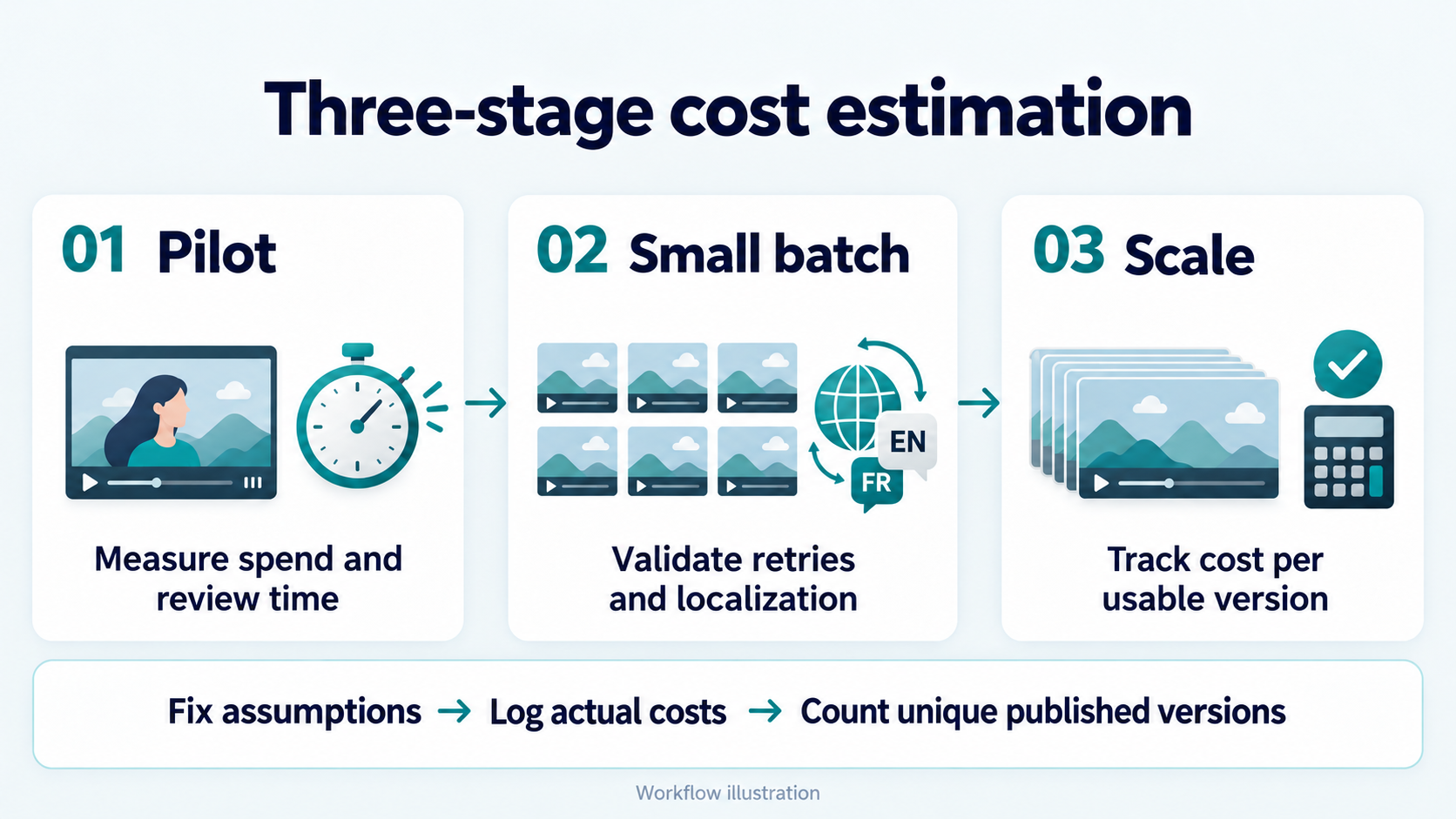
A pilot tests whether content meets your review criteria. A small batch checks retries, localization and handoffs. Scaled production should then be budgeted by batch, asset reuse and actual published deliverables.
The table below demonstrates one ledger across three stages. Every amount is an assumption. Generation lasts ten seconds per attempt at an assumed CNY 0.40 per second. Each final version has an initial attempt, with charged retries recorded separately. All target versions are assumed to pass review and be published. Labor, tool and storage costs are allocated to the corresponding stage. CNY 0.40 is not a product rate or a conversion of the reference credit table above. Paid attempts include only tasks with charges retained after returns are settled; refunded failures and cancellations are excluded.
| Budget item, CNY | Pilot: 6 usable versions | Small batch: 60 usable versions | Scale: 600 usable versions |
|---|---|---|---|
| Asset preparation | 80 | 240 | 600 |
| Initial generation | 24 | 240 | 2,400 |
| Charged retries | 16 | 160 | 1,600 |
| Localization | 160 | 800 | 5,000 |
| Human review | 120 | 600 | 3,600 |
| Version management | 40 | 200 | 900 |
| Distribution | 40 | 160 | 900 |
| Total | 480 | 2,400 | 15,000 |
| Paid generation attempts, including retries | 10 | 100 | 1,000 |
| Cost per usable version | 80 | 40 | 25 |
The calculations are 480 / 6 = CNY 80, 2,400 / 60 = CNY 40 and 15,000 / 600 = CNY 25. The decline comes from assumed asset allocation and labor costs. It is not a forecast that greater output will reduce costs. More languages, stricter review or additional rework could increase the unit cost.
Record shared scripts, brand rules and assets once, then allocate them under an agreed method. Do not charge the full preparation amount again to every language. The example also assumes one generated output per finished version; a multi-shot video requires a separate shot-level calculation.
How does the CNY 480 pilot budget add up?
Assume six unique versions are published, using ten paid ten-second generations at the illustrative rate of CNY 0.40 per second. Refunded failures or cancellations are not included in these ten attempts.
| Item | Calculation | CNY |
|---|---|---|
| Asset preparation | 1 hour × 80 per hour | 80 |
| Initial generation | 6 attempts × 10 seconds × 0.40 | 24 |
| Charged retries | 4 attempts × 10 seconds × 0.40 | 16 |
| Localization | 2 hours × 80 per hour | 160 |
| Human review | 1.5 hours × 80 per hour | 120 |
| Version management | 0.5 hours × 80 per hour | 40 |
| Distribution | 0.5 hours × 80 per hour | 40 |
| Total | 5.5 labor hours costing 440, plus generation costing 40 | 480 |
One generation costs CNY 4. The generation component allocated across six usable versions is CNY 6.67 each. The full cost is CNY 80 per version. Each number answers a different budgeting question.
If only four versions are published, the published-version cost becomes CNY 120. Keep the remaining approved files in a separate status. Reposting six unchanged files to more accounts does not increase the denominator.
Retries change the calculation. Holding other costs at CNY 440 and published versions at six, fifteen paid generations instead of ten raise the total to CNY 500, or approximately CNY 83.33 per usable version.
How should localization and human review be allocated?
Estimate localization by its layers: translated copy, voice, subtitles, on-screen text and market checks. Terminology, speakers and embedded text can produce different workloads even for the same number of deliverables.
List the actual market–language combinations, then the creative and platform files required for each combination. Do not mechanically multiply market count by language count. One language may serve several markets; a market may require several languages. Reuse identical files when suitable instead of regenerating them for every account.
Estimate review using actual hours multiplied by your team's internal cost rate. Use payroll, contractor or finance rules appropriate to your organization. CNY 80 per hour is only an arithmetic assumption. A checklist of review points helps explain rework better than a single “reviewed” flag.
The automotive and new-energy customer case illustrates a workflow connecting vehicle assets, creative production, localization and batch tasks. Its production scale does not establish another enterprise's price, labor savings or approval rate. Use the enterprise AI video production workflow guide to define your own task scope first.
How can teams compare tools without being misled by low rates?
Use the same assets, duration, specifications, languages, review criteria and deliverable count. Then compare the project ledgers.
| Comparison area | Questions to ask |
|---|---|
| Billing and retries | Which actions are charged? How are failures, cancellation and refunds handled? Can actual usage be recorded? |
| Acceptable deliverables | Do product details, people and brand presentation meet requirements? How much rework is needed? |
| Localization | Which layers are included? Which languages, voices or inputs need additional testing? |
| Review and versions | Can the team trace source assets, settings and final files? How much handoff work is required? |
| Distribution scope | Does the quote cover production only, or configuration and execution? Which account conditions apply? |
| Allocation | Are packages, tools, storage, tax and contractors accounted for consistently? |
Consider a hypothetical comparison: tool A charges CNY 0.40 per second and requires twenty paid ten-second attempts. Tool B charges CNY 0.80 per second and requires ten attempts. Both incur CNY 80 in generation fees. With CNY 440 in other costs and six published versions, both cost approximately CNY 86.67 per usable version. The example explains why workload matters; it does not rank specific tools.
For credit packages, distinguish the cash spent on the package from the credits consumed by a project. Record the package purchase in procurement cash flow and allocate consumed credits under an agreed unit cost. Do not add the full purchase again to that allocation. Trial credits can reduce trial cash spending; recurring budgets need sustainable paid rules.
What reduces wasted generation and rework?
Resolve incorrect inputs and unnecessary versions before deciding whether to change models.
- Fix product facts, terminology, brand requirements and permitted assets.
- Test a few representative shots at the intended specifications. Lower-specification pilots are appropriate only when they still test the relevant requirement.
- Change a small number of variables per round and record error types and revision reasons.
- Reuse suitable assets, terminology and brand treatments within their permitted scope.
- Approve samples before launching a batch to catch issues that affect every version.
- Record planned, paid, approved and published quantities, then review cost differences by batch.
A terminology correction may be solved by editing or localization instead of regenerating the whole video. Cost control should retain necessary review.
How can Smart BIAI support this budgeting method?
Smart BIAI AI Video Creation connects creative work, batch processing, localization and brand treatments in enterprise video workflows. Check model and specification choices in the current task interface. The reference credit table above applies to specified models and resolutions, rather than every available configuration.
Published release records offer a starting point for trial checks:
- V5.6.0 introduced multi-model choices with duration and resolution options that vary by model.
- V5.8.0 documents Seedance 2.0 Lite as a historical feature record; use the reference credits above rather than its historical price.
- V5.9.0 describes Seedance 2.0 Flash task-handling improvements, without a universal savings percentage.
Run representative tasks with your own assets and record usage, human time and publishable results. Then review plans and pricing. This is a team budgeting method; it does not claim that Smart BIAI automatically calculates full labor costs or cost per usable version.
Build a budget with your own production sample
Choose permitted assets for one product, intended markets, video specifications and review criteria. Run a small batch and measure actual usage.
Source verification scope
Sources were checked on 12 October 2026 against public website materials and existing release records. Reference credits, trial access, rounding, additive billing and failure / cancellation returns were added from product billing materials and the rules confirmed for this revision. Signed-in task billing was not tested. Check the platform for rates at other resolutions. Cost groupings and worked budgets are editorial methods; every demonstration amount and labor assumption requires replacement with actual project data.
Questions enterprise teams ask
1. How much does one enterprise AI video cost?
There is no price that applies to every project. Fix the assets, model, duration, specifications, languages and review requirements, then divide seven-category costs by the number of reviewed and published unique versions. CNY 80 in this guide is an illustrative result, not a quote.
2. Can model credits be treated as the final video price in CNY?
No. Model credits cover a specified model, resolution and generated duration. Processing can add credits. Allocate net consumption under your actual package rules, then include localization, human review and distribution. The reference cost for ten seconds of Flash 720p generation is 300 credits, not a complete video price in CNY.
3. How are failed, cancelled and retried Smart BIAI tasks billed?
Failed or cancelled tasks automatically return deducted credits to the account. A retry creates a new charged task. Budget net deductions after returns. A successful output that fails your team's creative review is not a system failure; do not assume an automatic refund.
4. Is a shorter or lower-resolution video always cheaper?
Duration and specifications can affect cost under a particular billing rule. Video processing rounds up per 30 seconds, so 30 and 31 seconds can differ by a whole unit; model generation remains per second. Check units and configurations before comparing models or task types.
5. Does publishing the same video on four platforms count as four versions?
One unchanged file is one unique deliverable; publishing events are recorded separately. Distinct language, aspect-ratio or content files can count individually when published.
6. Do trial credits remove the need to budget labor?
No. Flash and Lite offer free trials; other listed models require payment or a purchased package, subject to account rules. Asset preparation, localization and review still take time. Record trial cash spending separately and use sustainable paid rules plus labor for recurring budgets. A trial does not make all models free or provide unlimited use.
7. How can a team tell whether batch production reduced costs?
Compare batches using the same cost boundaries, review criteria and version definition. Track total cost, unique published deliverables and rework hours. Reuse may reduce repeated work, while more languages or tighter review may increase it.