
SHORT ANSWER
Define who the account serves and which questions its content answers, then choose relevant hashtags for each Reel or post. Hashtags, mentions, locations and private account labels have different purposes. Use current publishing limits and keep the content relevant.

How should Instagram hashtags fit a business account?
Define who the account serves and which problems its posts explain. Then choose hashtags relevant to each post's images and copy. A home-care brand can build topics around attachments, cleaning situations and product care without copying a generic trend list into every caption.
Sources reviewed November 2026. Check the current publishing interface for the allowed hashtag count, and keep the most relevant terms rather than copying older fill-all-30 templates. The product examples below show how to choose relevant topics.
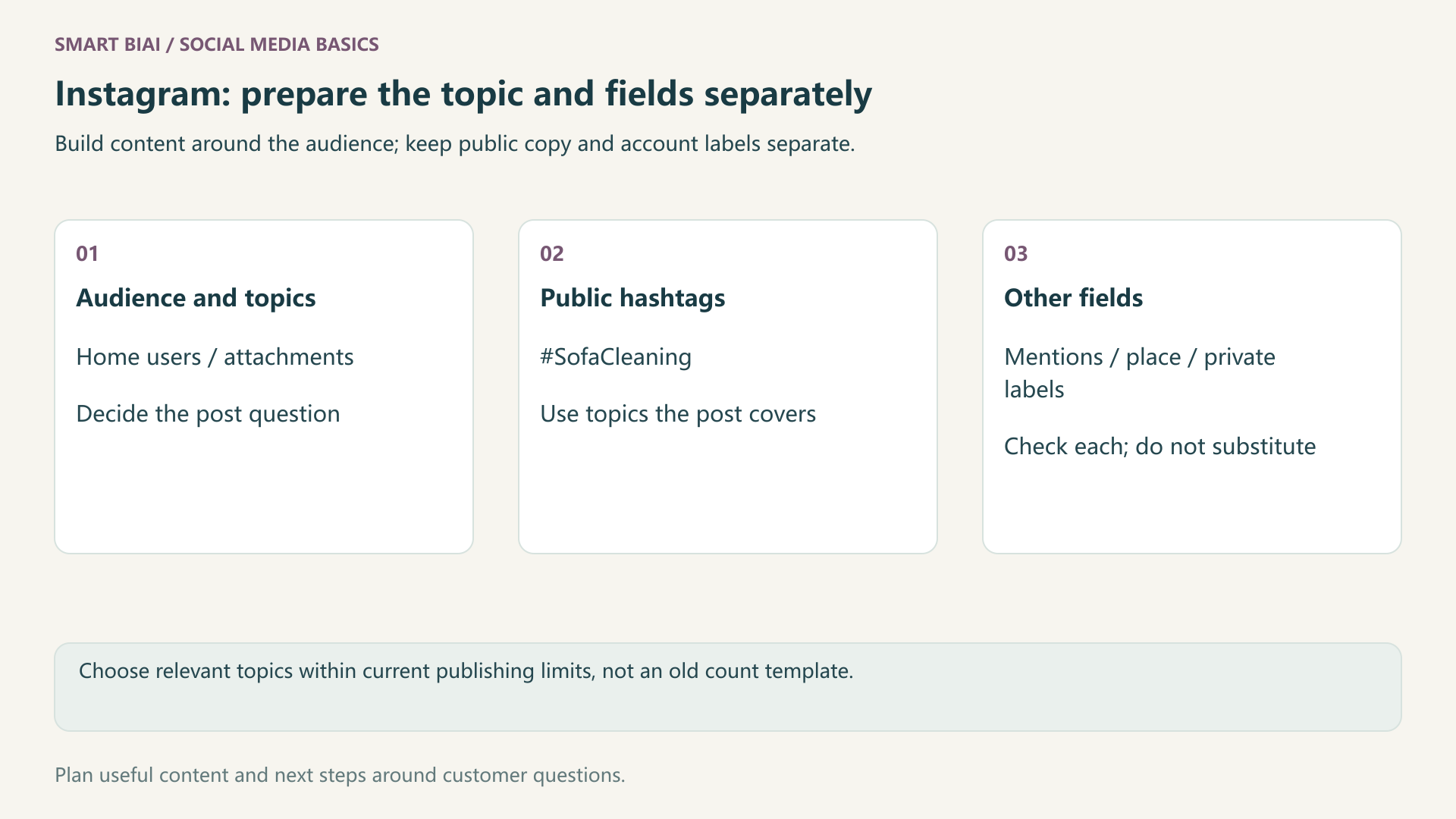
1. Separate hashtags, mentions, locations and account labels
| Item | What it communicates | Practical check |
|---|---|---|
| Public hashtag | The topic discussed by this post | The footage and copy actually cover it |
| Account mention | A real connection to another account | The identity and relationship are correct |
| Location | A place related to the content | The place is relevant and the publishing method supports it |
| Private account label | The team's way of organizing accounts | Market, language and purpose remain separate from public copy |
A US home-care label helps organize the account. Add the post's location, mentions and hashtags separately when publishing.
2. Define useful recurring content topics
Describe the account's purpose in a sentence. Helping household users operate and care for a cordless vacuum provides a clearer basis for topics than trying to post about every trend.
Use product information, sales questions and feedback from existing work. Reels can show an action, carousels can explain details, and Stories can invite further questions. The examples below show how topics and posts can connect for one product.
| Recurring topic | Post question | Material to prepare | Related terms to research |
|---|---|---|---|
| Attachments and use | Which head fits a sofa crevice? | A short demonstration and detail images | #VacuumCleaner, #SofaCleaning |
| Storage and space | Where can it fit in a small home? | Actual storage photos and dimensions | #HomeOrganization, #VacuumStorage |
| Product care | How should this filter be cleaned? | Steps matching the product instructions | #VacuumCare, #CleaningTips |
Use the real product, dimensions, procedure and limitations. For example, follow the product instructions on whether its filter can be washed.
3. Research candidates and remove unrelated terms
Write the question in the audience's natural language, then inspect related accounts, posts and topics in the search options currently available. Examine meaning, local usage and the content shown. Suggestion order or the size of a topic page is not a verified demand measure.
Check that the term, post and intended audience fit together. Keep brand terms when they help organize your own work. Remove unrelated trends, campaign names and place terms.
Use the current field limits. If the interface requests fewer hashtags, keep the most relevant candidates. Repeated comment blocks are not a useful workaround, and app and third-party publishing fields should be checked independently.
4. Match the selection to the post's purpose
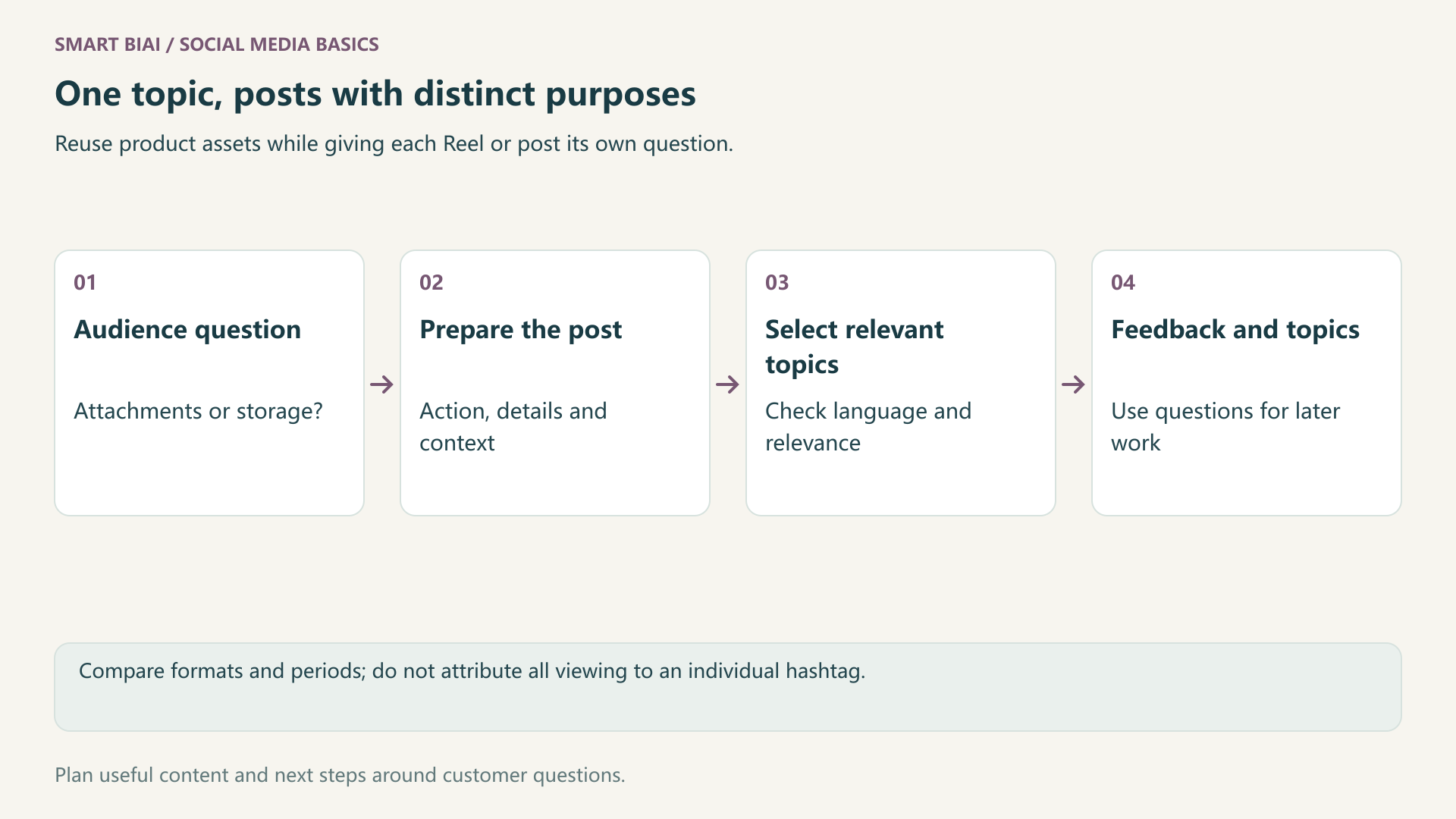
A Reel demonstrating sofa cleaning and a carousel comparing attachments can share a genuine product term. Their more specific topics may differ because the posts answer different questions.
Consumer tutorials and distributor product information also serve different readers. Adapt the title, image order, explanation and topics to those readers, rather than only changing a country label.
5. Use feedback to choose the next topic
Compare similar content formats and observation periods. Review the account's views, reach, saves, interactions and profile visits. Recurring questions can suggest a more useful next post than another generic hashtag list.
| Observation | What to inspect | Possible next step |
|---|---|---|
| Detail images are saved | Whether the part, dimension or step is useful | Build a related series |
| Demonstrations leave many questions | Whether the action and captions are clear | Add a close-up or an explanatory carousel |
| Comments are largely irrelevant | Whether the positioning and topics drifted | Adjust the explanation as well as the terms |
| Profile visits lead to little further action | Whether the profile and destination match | Check the actual visit and inquiry route |
Meta's Best Practices announcement describes professional-dashboard guidance on creation, engagement, reach and other topics, including personalized tips. Use it if available alongside your own data; one change in views cannot isolate a hashtag's effect.
6. Organize multiple accounts and content tasks
Smart BIAI helps organize product assets, language versions, account categories and publishing tasks. Find the intended market and account purpose, then check the post's copy, hashtags, assets and schedule rather than sending an identical package everywhere.
Check the copy, mentions and location options before publishing. Complete settings your tool does not provide in Instagram. You can discuss managed social media support if you need a team to help with account operations, content distribution and analysis.
Continue reading
Questions enterprise teams ask
Are more Instagram hashtags always better?
Use relevant terms within the current publishing limits. Filling every available slot is not a substitute for useful content or a reach guarantee.
Can every post use the same set?
Reuse a product or brand shortlist, but review it when the question, setting or post purpose changes.
Can mentions, locations and hashtags replace one another?
They describe different things. Check the genuine relationship, place or topic and the supported field separately.
Do private account labels add public topics to posts?
No. Private labels organize accounts. Public topics must be written in the appropriate copy or supported field.
Can a first comment bypass a hashtag limit?
Do not use repeated hashtag blocks as a workaround. Follow the current field requirements and keep the main explanation clear.
Can one hashtag's inquiry contribution be calculated precisely?
Overall post figures usually cannot isolate an individual hashtag's contribution. Review post results, profile visits and inquiries together rather than crediting one hashtag.