SHORT ANSWER
Official APIs, browser login, and account environment isolation address different needs: platform-authorized actions, human-operated tasks, and separate account configurations. Smart BIAI currently connects four platforms through official APIs, supports batch and cross-platform publishing, provides per-account browser and network configurations, and asks operators to confirm publishing time and AI disclosure before publishing.
Three connection methods solve three different problems
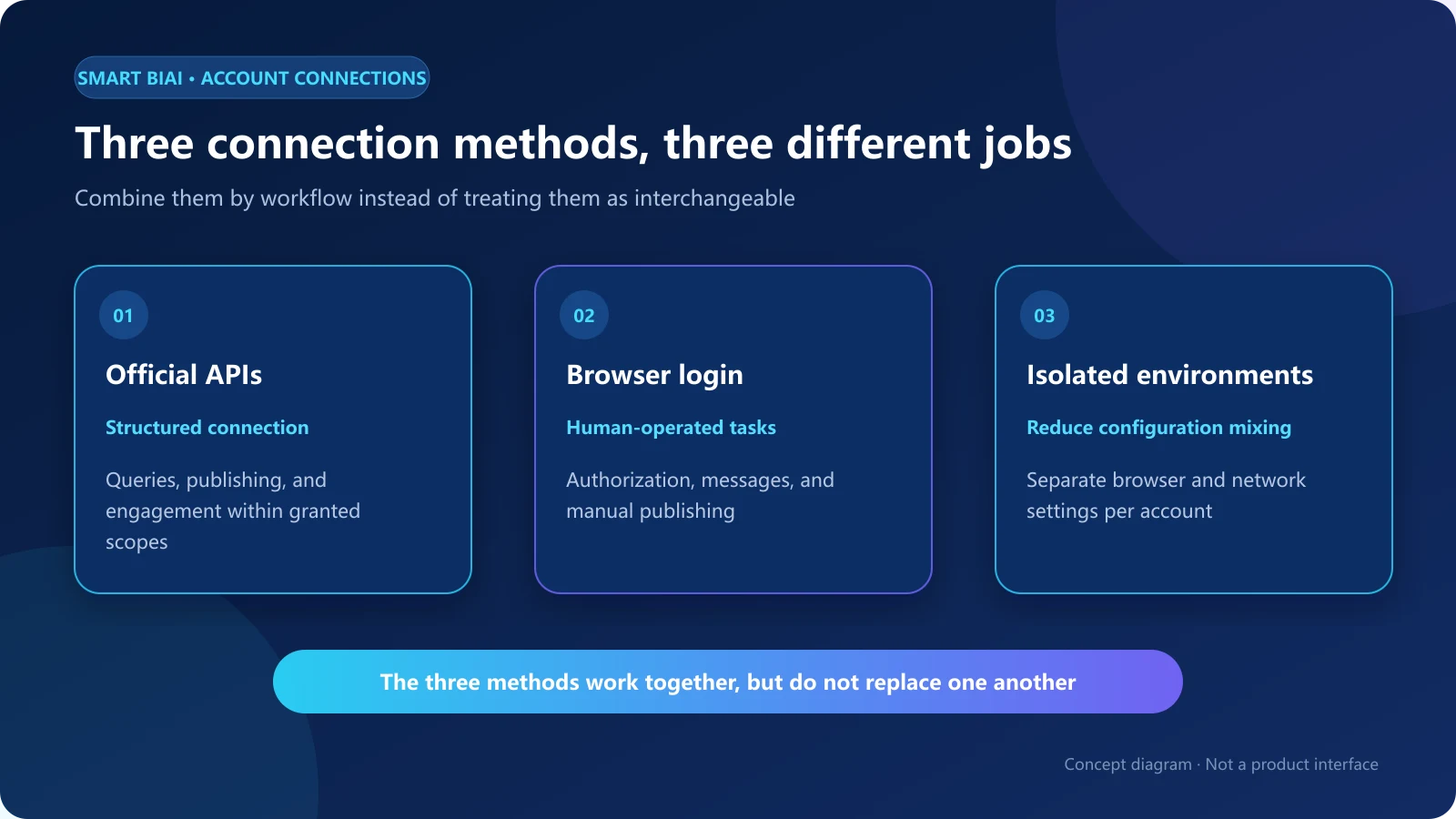
Teams operating TikTok, YouTube, Instagram, and Facebook accounts often treat official API authorization, browser login, and account environment isolation as the same thing. They are not. Official APIs let a system query data, publish content, or manage comments within permissions granted by the account owner. Browser login supports tasks that an operator must complete on the platform interface, including authorization, messages, and manual publishing. Account environment isolation keeps browser and network configurations separate for each account. The three methods can work together, but they are not interchangeable. An API does not expose every function available on a platform website. A browser session does not grant API permissions. An isolated environment does not bypass platform rules or guarantee availability across every platform and region.
1. Official APIs connect only the capabilities a user authorizes
With official API authorization, the user reviews the application, account, and requested permission scopes on the platform authorization page. The system can act only after the platform grants those permissions and only within the granted scope. Smart BIAI currently supports long-lived authorization. A user can disconnect an account in Smart BIAI or revoke the application from the social platform's account settings. Long-lived does not mean permanent: user revocation, platform changes, account-status changes, or expired authorization may stop a capability and require reauthorization. Teams should request permissions according to the work they need to perform. A reporting-only team does not need the same scope as a team that publishes content and replies to comments. Available scopes ultimately depend on the platform authorization page, account type, region, and current APIs.
2. What the four platform connections currently support
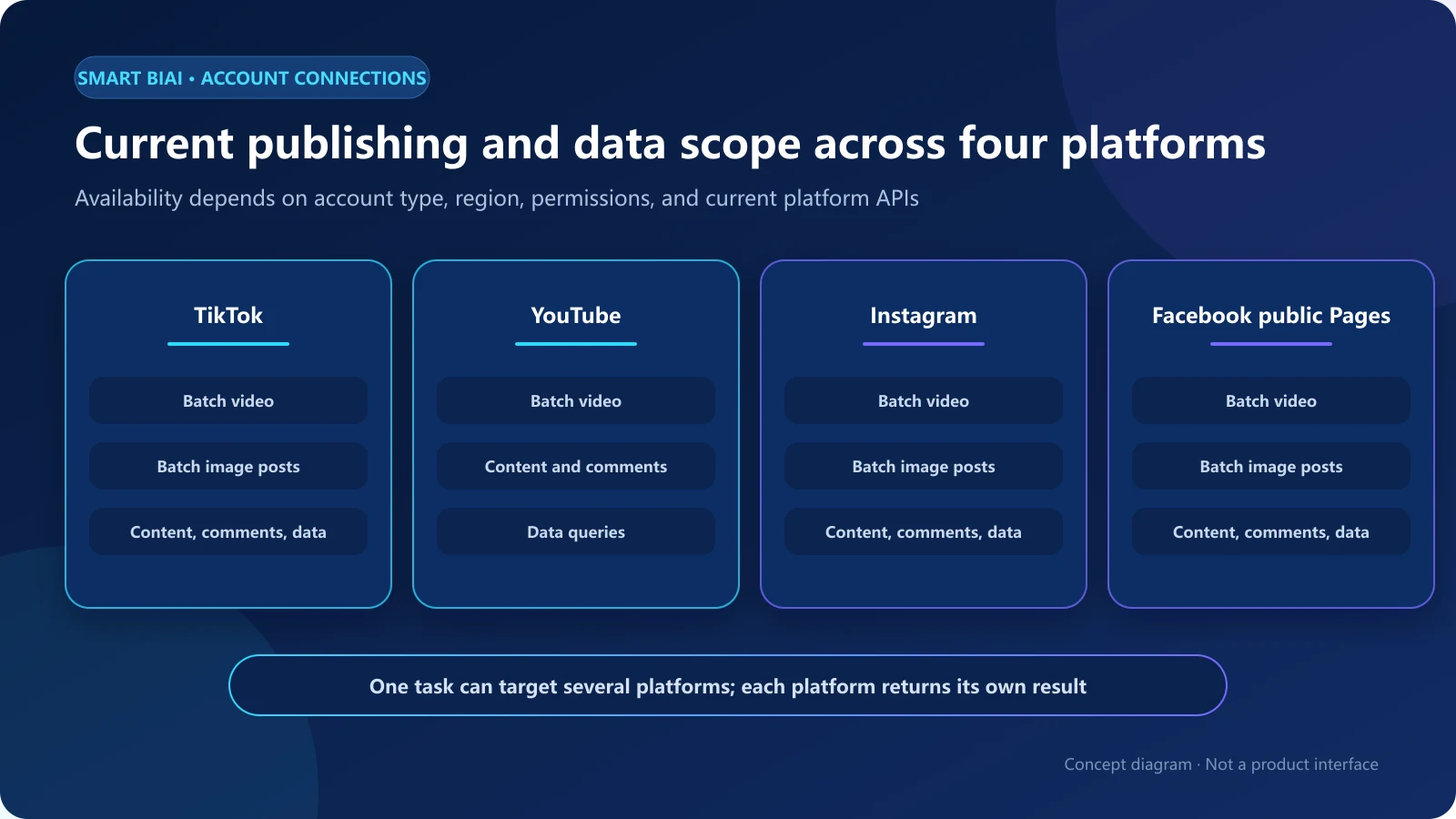
When account type, region, and permissions allow it, Smart BIAI connects TikTok, YouTube, Instagram, and Facebook through official APIs. Current workflows cover account profiles, account content and performance data, publishing, comment lists, and comment replies. All four platforms support batch video publishing and cross-platform publishing. TikTok, Instagram, and Facebook also support batch image-post publishing. Facebook support currently applies to public Pages rather than personal profiles or every Facebook asset. For eligible TikTok accounts, follower gender and geographic distribution are available when the account has more than 100 followers. TikTok video and image-post workflows can also use available trending music, hashtags, and location fields. The fields shown in a publishing workflow depend on the connected account and the platform interface at that time. The same video can be selected for distribution to all four platforms, but each platform validates its own fields, media specifications, permissions, and content rules. A completed post on one platform does not mean every other platform completed at the same time.
3. TikTok Shop has separate eligibility requirements
TikTok Shop API authorization currently supports ordinary showcase accounts that already have product-promotion capability, plus a shop's official account and marketing accounts. Within the granted scope, Smart BIAI can manage showcase products, publish shoppable videos and image posts, and query order volume and GMV associated with shoppable content. Availability still depends on market, the relationship between the shop and account, platform access, and authorization status. TikTok Shop eligibility should be checked separately from ordinary social-account authorization.
4. Browser login keeps human-operated tasks available
Even after API authorization, some work still happens on the platform interface. Smart BIAI browser login is currently used to sign in and complete API authorization, review account information, view and handle direct messages, publish manually, and manage tasks that are not available through an API or require confirmation on the platform page. Browser login still follows each platform's rules. Teams should confirm asset rights, content, and account actions before publishing. An isolated environment does not change how a platform evaluates content or account activity.
5. Account environment isolation keeps configurations separate
Smart BIAI can create a separate browser environment for each social account and assign an independent network configuration. Environment configurations synchronize through the cloud, so the relevant setup can follow the operator when switching devices and reduce accidental mixing between accounts. This is useful when one team manages many accounts, markets require separate network configurations, or operators work across several devices. It is not an account-stability guarantee. Platform, region, network, browser-version, and login-rule changes can affect availability, and Smart BIAI does not promise one-hundred-percent availability in every platform and region.
6. Publishing still requires human confirmation
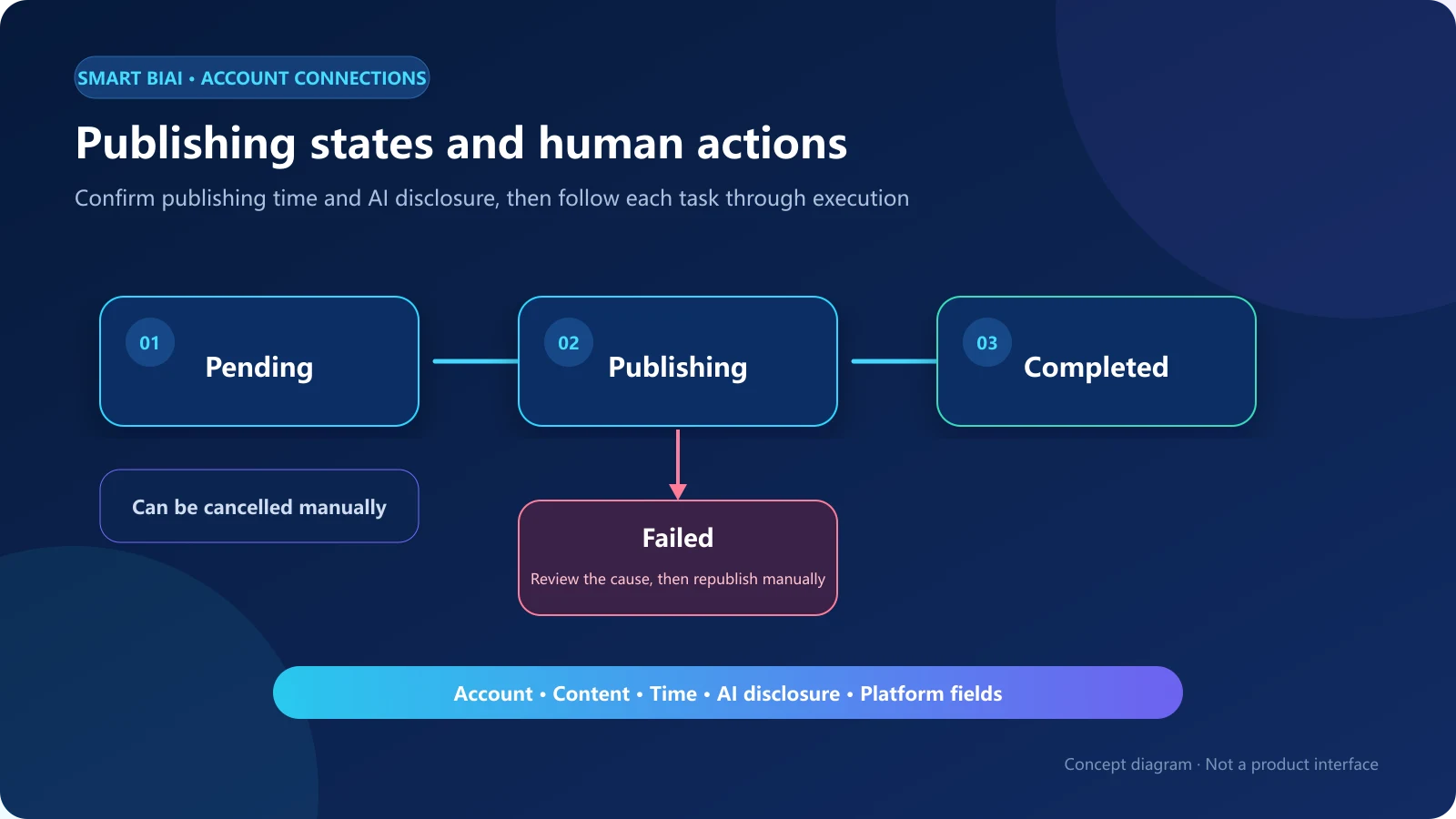
Batch publishing does not remove human review. Smart BIAI currently requires an operator to confirm the publishing time and the AI-generated-content disclosure before publishing. Teams should also verify the media, copy, target account, required platform fields, and rights to any music or other assets. Titles, hashtags, locations, music, and AI disclosures may need separate confirmation for each platform. After a publishing plan is created, a task moves from pending to publishing and then to completed or failed. Pending tasks can be cancelled manually. Failed tasks can be republished manually after the operator checks authorization status, required fields, media specifications, and account status.
7. Batch, smart, and cross-platform publishing
Batch video publishing creates tasks for multiple accounts at once. Smart publishing uses configured rules to generate scheduled plans, while retaining confirmation of content, account, time, and AI disclosure. Cross-platform publishing lets a team select the same video for TikTok, YouTube, Instagram, and Facebook in one workflow. TikTok, Instagram, and Facebook also support batch image-post publishing. Because available fields and publishing outcomes differ by platform, teams should still check the status and failure reason for every destination after creating a batch.
8. How enterprises can combine the three methods
A practical model is to use official APIs for standard actions exposed by the platforms, browser login for authorization, messages, manual publishing, and exceptions, and isolated account environments to reduce configuration mixing. Operators keep the final confirmation before external publishing and respond to cancelled, failed, and republished tasks according to their status. Start with one market, a small account group, and one real publishing workflow. Verify the authorization entry point, account type, scopes, human tasks, environment setup, publishing confirmation, task states, and revocation path. Expand to more accounts, platforms, and teams only after the complete workflow is clear.
Questions enterprise teams ask
Is official API authorization the same as logging in through a browser?
No. API authorization lets a user approve an application and specific permission scopes on the platform page. Browser login is used for human-operated tasks such as authorization, account review, direct messages, and manual publishing.
Does long-lived API authorization last forever?
No. Smart BIAI supports long-lived authorization, but users can revoke it, and platform or account changes may require reauthorization.
How can an account owner revoke access?
The user can disconnect the account in Smart BIAI or revoke the application in the social platform's account or application settings. API-dependent data, publishing, and interaction features stop after revocation.
Does an isolated browser environment prevent account restrictions?
No. It separates browser and network configurations and supports configuration synchronization across devices. Account status still depends on platform rules, content, operator behavior, region, and network conditions.
Can one video be published to all four platforms?
Yes. A cross-platform task can target TikTok, YouTube, Instagram, and Facebook. Each platform still validates permissions, media specifications, and publishing fields independently.
Which platforms support batch image-post publishing?
TikTok, Instagram, and Facebook currently support batch image-post publishing in Smart BIAI. Facebook support applies to public Pages. Exact fields depend on platform APIs, account type, region, and granted permissions.
What must be confirmed before publishing?
The operator must confirm publishing time and AI disclosure. The team should also verify content, target accounts, asset rights, and required platform fields, including music, hashtags, or locations when used.
Can a pending task be cancelled or a failed task be retried?
Pending tasks can be cancelled manually. Failed tasks can be republished manually after the operator reviews the failure reason and authorization status.
What does Facebook support currently cover?
Smart BIAI currently supports profile and content queries, batch video and image-post publishing, comment management, and data queries for Facebook public Pages, subject to the permissions shown during authorization.
Which TikTok Shop accounts can authorize the API?
Eligible ordinary showcase accounts, a shop's official account, and shop marketing accounts can authorize the current workflow. Granted capabilities include showcase-product management, shoppable video and image-post publishing, and eligible order-volume and GMV queries.