
SHORT ANSWER
Start with a goal and group video versions by SKU, market, language and platform. Using two backpacks, two markets and two openings, this guide builds eight candidates in four comparison groups, connects creative IDs to published posts, and explains matching observation windows, metric definitions and next-round decisions.

Article
Start AI video testing with a goal, then hold the product, market, language, platform and main production conditions steady. Change one creative factor in the first round, such as the opening. Connect each version to its assets, published posts and observation data. Compare within a defined group before deciding what to keep, revise or retest. Generating more versions does not by itself create a useful test.
A creative matrix should show which versions express the same product differently, which belong to another product or language, what was actually published, and whether the data covers a comparable period. Without that structure, a report full of view counts may still offer little guidance for the next round.
Start with the decision this round should support
Choose a primary goal, then a primary measure and the supporting information it needs. Encouraging continued viewing, attracting product-page visits and generating qualified inquiries are different questions. Set the decision criteria before publishing so the results can guide the next action.
| Goal | What to examine first | Conditions to retain |
|---|---|---|
| Help people keep watching and understand the product | Where available, viewing depth, average viewing time or relevant retention data | Same platform and format, similar duration and consistent metric definitions |
| Encourage visits to product details | Available website clicks, site visits and the denominator used | Matching destination, link placement and observation scope; distinguish platform clicks from site visits |
| Generate qualified inquiries or sales opportunities | Collected form, order or other business events and their quality | Attribution rules, the definition of a valid outcome, observation period and exceptions |
If only views, likes and comments are available, begin with content feedback. Assessing inquiries or sales requires the corresponding business data. Mark unavailable measures as unavailable to distinguish them from zero.
Which fields define a group, and which factor changes?
The product, market and language usually define a group's business scope. Openings, selling points, settings and calls to action can then be changed in separate rounds. In a first comparison of two openings, keep the other expression and production conditions consistent so the source of a difference is easier to understand.
| Field | Role in this round | Arrangement |
|---|---|---|
| Product / SKU | Grouping condition | Compare the same model within a group; retain its specifications and feature descriptions |
| Market | Grouping condition | Examine the US and Germany separately instead of pooling a winner ranking |
| Language | Grouping condition | Use language suited to the local audience and record localization differences |
| Opening | Factor changed | H1 asks a question; H2 starts with an outcome |
| Main selling point | Fixed condition | Use the same verified product information within a group |
| Main setting and demonstration | Fixed condition | Retain the demonstration and shot arrangement; check the finished outputs |
| Call to action / CTA | Fixed condition | Use the same details destination and action copy |
Record the platform, account or traffic allocation, aspect ratio, target length, music and publishing arrangement too. A different platform needs a new comparison scope. A different model, prompt, source image or voice can introduce other changes. Even when only an opening prompt changes, AI output may alter the main sequence, so compare the actual finished files.
For turning reference structures into a new script, see creative analysis and original recreation. Once the script is ready, decide which part of its expression this round should examine.
An eight-version plan: two SKUs, two markets and two openings
Suppose the team has a commuter backpack, B01, and a travel backpack, B02, for US English and German-language audiences in Germany. Plan the candidates for one platform. H1 introduces a question; H2 first shows the packed result. Keep the main demonstration, duration and CTA consistent within each group.
2 SKUs × 2 markets × 2 openings = 8 candidate versions in 4 groups, with 2 openings per group.
| Group | SKU | Market / Language | Opening | Creative ID |
|---|---|---|---|---|
| G01 | B01 commuter backpack | US / English | H1 Question | B01_US_en_H1 |
| G01 | B01 commuter backpack | US / English | H2 Outcome first | B01_US_en_H2 |
| G02 | B01 commuter backpack | Germany / German | H1 Question | B01_DE_de_H1 |
| G02 | B01 commuter backpack | Germany / German | H2 Outcome first | B01_DE_de_H2 |
| G03 | B02 travel backpack | US / English | H1 Question | B02_US_en_H1 |
| G03 | B02 travel backpack | US / English | H2 Outcome first | B02_US_en_H2 |
| G04 | B02 travel backpack | Germany / German | H1 Question | B02_DE_de_H1 |
| G04 | B02 travel backpack | Germany / German | H2 Outcome first | B02_DE_de_H2 |
Compare H1 and H2 within G01, then examine G02, G03 and G04 separately. More views for the US version do not establish that English creative is better than German creative: the market and audience differ. With limited budget or maintenance time, start by executing G01's two versions and keep the other groups as planned work.
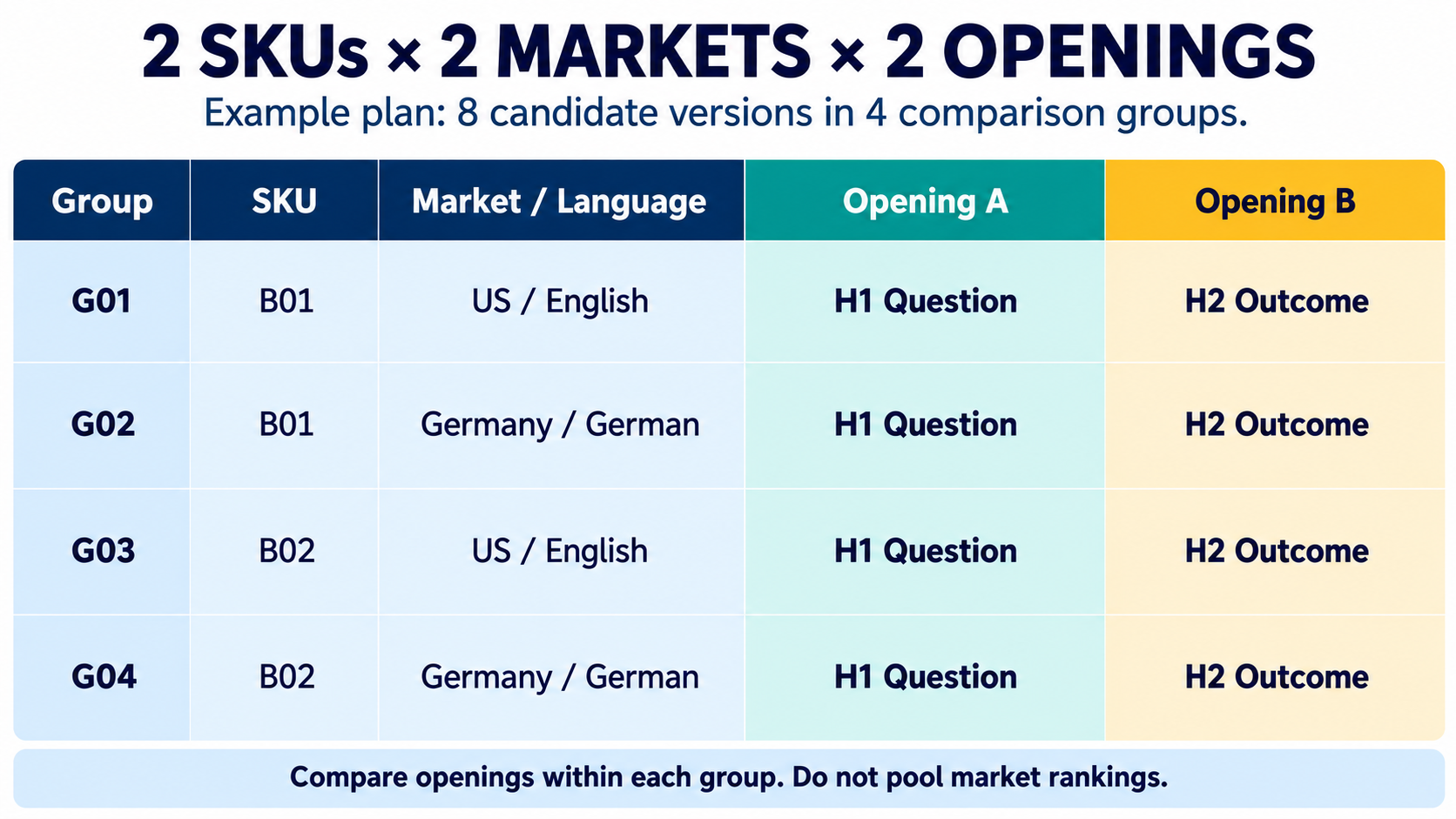
Adding three platforms, two lengths and two CTAs to those eight combinations creates 96 candidates. More versions require more production time and observation data. Establish a useful small comparison before expanding the number of versions.
Name versions so you can find the file that was actually published
Separate the creative ID, finished-file version and published post. B01_US_en_H1 identifies a creative idea. B01_US_en_TT_G01_H1_v01 could be its filename. Save subtitle or shot revisions as v02, while keeping old publishing records connected to the file they used.
A filename helps people read the record; a stable ID supports the relationship. “New final” should not be the only identifier. Do not overwrite an old file after results arrive and leave the same version pointing to two different videos.
| Layer | Suggested records | Question it answers |
|---|---|---|
| Creative plan | Group, creative ID, hypothesis, changed factor and fixed conditions | What is this round comparing? |
| Production and finished file | Source assets, script and prompt versions, model and task settings, final file and version | What was made, and did other elements change? |
| Published post | Publishing task, platform, account, actual publication time, post ID, public URL and status | What was actually published, and where? |
| Observation data | Data source, reporting scope, capture time, time since publication, definitions and availability | Which post and period does this observation describe? |
If one file is posted to two accounts, retain two publishing relationships. Keep the platform, account and post ID instead of matching by title alone. A failed or unpublished task does not belong in a group of published videos with zero views. See the enterprise social content library guide for asset organization.
Where the platform and account support a suitable link placement, utm_content=b01_us_en_h1_v01 can distinguish the creative version while source, medium and campaign parameters remain consistent. Google Analytics documents the fields in its manual tagging guide. Collect link parameters alongside form, order or other business events to examine what happens after a visit. Cross-device activity, lost parameters and unrecorded events affect attribution coverage.
Check five conditions before comparing data
- Platform and format. Similar view labels across platforms do not necessarily describe the same viewing event. Retain definitions for watch-time measures too; consult the YouTube metrics reference.
- SKU, market and language. Keep different configurations and localized expressions separate. Automotive models and sales markets, or hardware models and interfaces, need more detail than a shared brand label.
- Account and distribution. Record account context, timing and organic or paid delivery. Paid comparisons also need audience, budget, optimization goal and traffic allocation details.
- Observation window. Distinguish calendar-day totals, cumulative data and matching time since publication. Retain time zone and capture time. Observing the first 48 hours is one possible choice for a round, not a universal test duration, and does not remove date or audience differences.
- Metric, denominator and synchronization. Identify the sources of views, impressions, clicks, visits and inquiries. Missing permissions, fields not returned and unsynchronized data are unavailable, rather than zero.
Two organic posts are not automatically a randomized A/B experiment. The platform may deliver them to different people even when only the opening changes. The Google Ads experiments overview describes control groups, treatment groups and traffic allocation. Distinguish that arrangement from observing posts side by side. Formal experimental conclusions need a design and decision method suited to the situation.
Should the version with more views be kept?
Return to the goal before deciding. Consider this hypothetical example: both openings have the same observation scope, and website-click counts are available for each.
| Version | View count | Website-click count | Website clicks per 1,000 views |
|---|---|---|---|
| H1 Question | 4,000 | 80 | 20 |
| H2 Outcome first | 2,000 | 60 | 30 |
The calculation is website-click count ÷ view count × 1,000. H1 has more total views and clicks; H2 has a higher ratio on this measure. If the round concerns product-detail visits, H2 may be worth further investigation instead of being discarded on views alone.
The denominator is views, not ad impressions, so this is not platform CTR. Neither count necessarily represents unique people. Whether the difference is reliable still depends on the sample, distribution conditions and further observation. If the objective is qualified inquiries, clicks from either version do not replace confirmed inquiry outcomes.
Turn the result into a next-round action
Record the SKU, market and goal the decision applies to, then set the next step. With a limited sample or missing data, choose to keep observing.
| Observation | Treatment in this round | Next-round action |
|---|---|---|
| Comparable conditions and a consistent direction across observations | Keep a candidate and record the SKU, market and goal it applies to | Retest in a new comparable arrangement before expanding other factors |
| More views but weak downstream activity | Examine audience fit, the information sequence, CTA and landing page | Choose one factor to adjust while retaining the other conditions |
| Limited sample, unavailable fields or materially different delivery | Defer a winner decision and collect data or redesign the comparison | Record the gap and next review time; do not turn unavailable values into zero |
| Incorrect product descriptions, unclear asset rights or a faulty output | Pause publishing and correct the product information, assets or video | Give the revision a new version and retain the old data relationship |
Keep files, goals and groups stable during observation. Record changes or open another round when production, publishing or observation arrangements change. Retest through a new publishing and observation arrangement; repeatedly reading the same data is not independent validation.
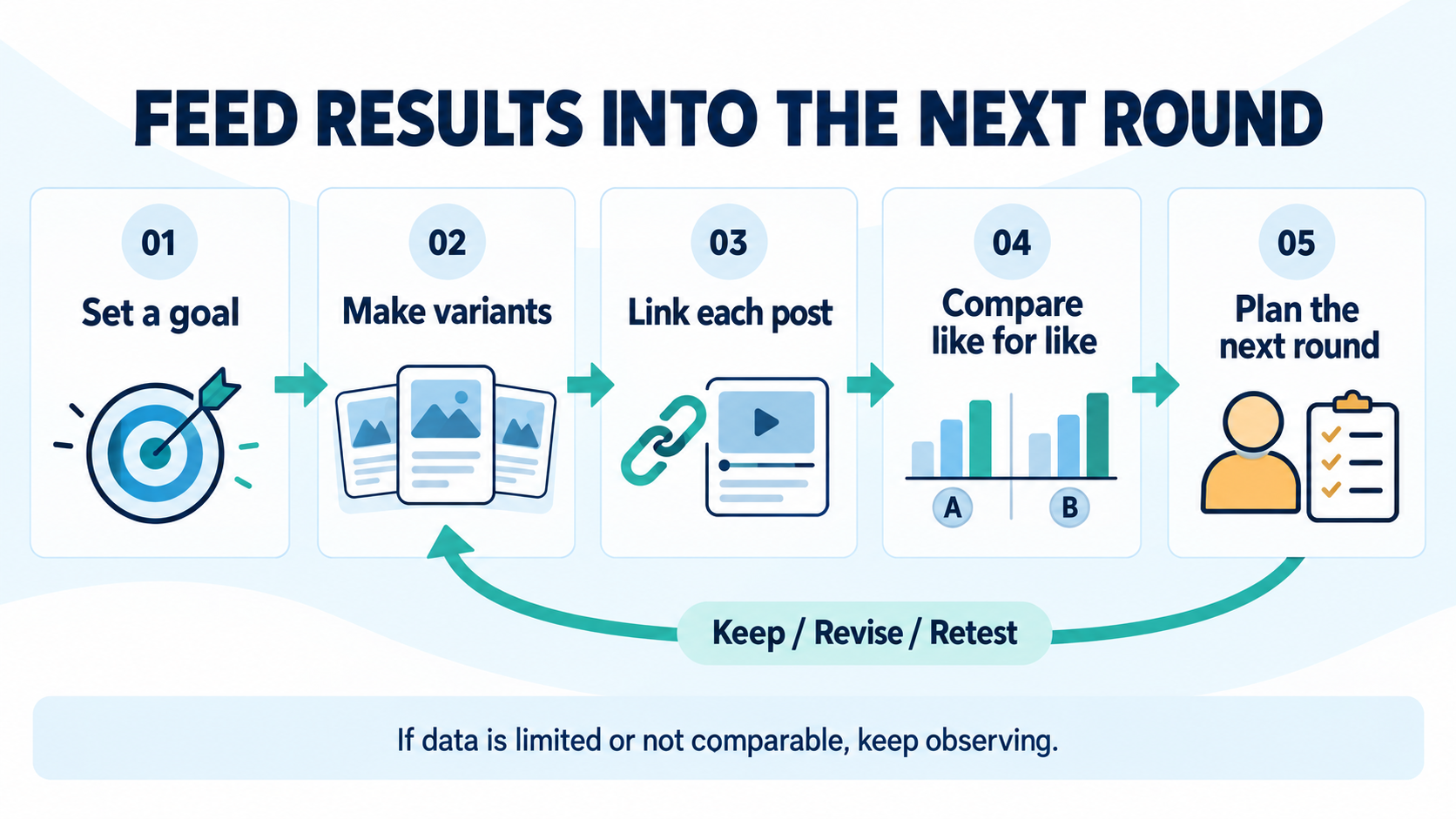
How does Smart BIAI connect production, publishing and review?
Smart BIAI AI Video Creation can start from product links, text, images or source footage and connect to variants, localization and brand treatment. Organize product specifications, selling points and usable assets, then prepare scripts from the matrix. Compare the demonstration, duration and CTA in the finished videos to check that only the intended factor changed.
After publishing, connect creative IDs to accounts, posts and reporting scope. Use the cross-platform social data guide to identify available measures and their sources. Smart BIAI Agent can use authorized data to organize changes, possible explanations and next tasks, helping the team return to the relevant posts and decide which version to retest.
For examples of connecting multilingual production with account operations, see the automotive multilingual video case and smart hardware content operations case.
Start with a shared table for groups, versions and observations. As the number of SKUs, languages or participating teams grows, establish consistent links between assets, publishing tasks and data. Discuss an enterprise workflow with Smart BIAI, starting with one comparable group of creative tasks.
Before starting the round
- Write the question, primary goal and intended measures before seeing results.
- Confirm each group's SKU, market, language, platform and distribution conditions, and identify the one creative factor changing.
- Check product descriptions, asset permissions and finished videos; retain script, prompt and file versions.
- Connect the account, task status, post ID, public URL and actual publication time.
- Define the window, time zone, capture time, denominators and unavailable fields; retain platform and website data separately.
- Agree when to review and what information the current decision requires, including when to defer a conclusion.
Questions enterprise teams ask
1. How many AI video versions should the first round include?
Start with two openings for one SKU, market and platform. Once the group can be published, linked to data and compared, expand to other products and markets. There is no need to execute all eight candidates at once.
2. How many variables should change in one round?
For an initial comparison, change one creative factor, such as the opening, and retain the other conditions. A complex multi-factor experiment needs an appropriate design. Arbitrary combinations of changes cannot be attributed to one factor.
3. Can several markets and languages be ranked together?
They can be viewed alongside one another, but first compare within the same SKU, market, language and platform. Audiences, delivery and product conditions differ across markets. Total views alone cannot establish a better language or creative approach.
4. Are several organic posts an A/B test?
Not automatically. Organic posts usually lack randomized comparable traffic allocation; account, date and audience can influence the outcome. Treat them as creative observations. Causal or formal experimental conclusions need an appropriate allocation and experimental method.
5. How do I connect video versions to publishing data?
Retain the creative ID, finished-file version, platform and account, publishing task, post ID and public URL, then record the reporting scope and capture time. Keep separate relationships when one file is posted to several accounts rather than guessing from titles or filenames.
6. Is there a universal duration or view-count threshold?
No single number fits every goal and channel. Plan around traffic volume, outcome frequency, the business decision and the experimental method. Continue collecting data when it is insufficient or incomparable; a fixed number of days does not automatically produce a winner.
7. Do UTMs identify every inquiry or order generated by a video?
No. They label traceable link visits; the website must collect the parameters and relevant events. Link-placement limits, lost parameters, cross-device activity and attribution rules affect coverage. Missing conversions cannot be assigned with certainty.
8. How can Smart BIAI help with the next creative test?
Produce versions from the matrix and connect each finished video to its posts and available data. Use changes and suggestions organized by Agent to examine the audience, opening, demonstration and CTA, then choose one factor for the next round. A formal A/B experiment also needs a separate traffic-allocation and statistical decision design.